What is Extreme Skiing? A Complete Guide
What Defines Extreme Skiing?
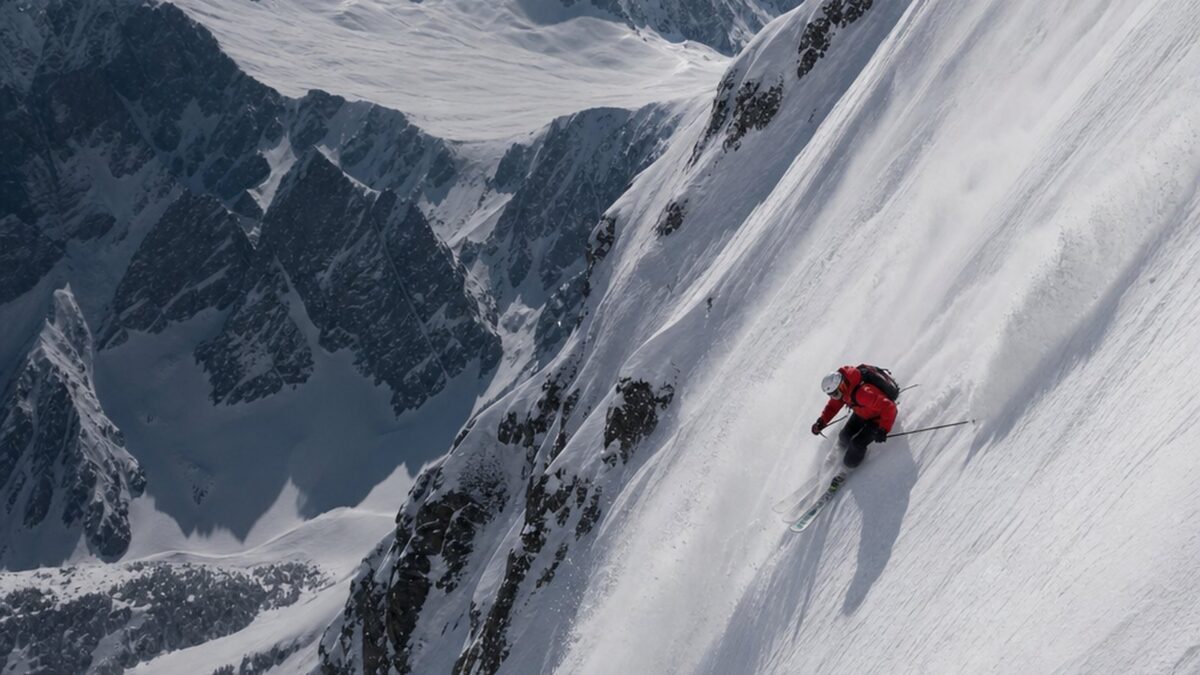
Extreme skiing is the discipline of skiing down steep, hazardous, and ungroomed terrain under the most challenging conditions. While a standard off-piste run might offer powder and adventure, extreme skiing elevates the risk and required skill level exponentially. The term typically applies to descents on slopes of 45 degrees or steeper, often in ‘no-fall’ zones where a single mistake could be fatal.
However, the definition goes beyond simple gradient. It encompasses a range of high-consequence features, including:
- Couloirs: Narrow chutes or gullies, often flanked by rock walls.
- Cliff Drops: Intentionally skiing off cliffs, requiring precise control of speed and landing.
- Exposure: Skiing on faces where a fall would lead to a long slide over rocks or ice.
- Variable Snow: Navigating unpredictable conditions from deep powder to wind-scoured ice within a single run.
Originally coined by French skiers in the 1970s as ‘Le Ski Extrême’, the sport was initially about pure survival—simply making it down a terrifyingly steep face on long, straight skis. Today, while the core challenge remains, it has blended with elements of freeride, incorporating fluid style and aerial manoeuvres into these high-stakes environments.
The Pioneers of Steep Descents
Before fat skis and action cameras, a handful of courageous individuals pushed the limits of what was considered possible on snow. They relied on mountaineering skills, immense courage, and rudimentary equipment to etch their names into history.
Sylvain Saudan
Often called the ‘father of extreme skiing’, this Swiss skier pioneered techniques for controlling speed on impossibly steep faces. In the late 1960s, he developed the ‘windshield-wiper’ turn, a method of keeping the skis on the snow while pivoting back and forth. Saudan completed over 18 first descents on some of the world’s most formidable peaks, including Mont Blanc and Mount Kilimanjaro.
Bill Briggs
In 1971, American ski mountaineer Bill Briggs achieved what many thought was impossible: the first ski descent of the Grand Teton in Wyoming. At a time when steep skiing was largely a European affair, his claim was met with widespread disbelief. To prove his feat, Briggs chartered a plane the next day to photograph his tracks snaking down the iconic peak, creating an image that became legendary in the American ski community.
Yuichiro Miura
Japanese skier Yuichiro Miura brought a unique and audacious approach to the mountains. After attempting to set a speed skiing record, he conceived a new challenge: skiing down Mount Fuji so fast that he would need a parachute to slow down. In 1970, he applied this daredevil philosophy to Mount Everest, skiing down the South Col. His parachute failed in the high winds, and he slid uncontrollably for hundreds of metres, stopping just short of a massive crevasse.
The Film Stars Who Inspired a Generation
In the 1980s and 90s, a new wave of skiers brought the sport from the remote peaks to the cinema screen. Ski films transformed extreme skiing into a global phenomenon, inspiring countless skiers to look beyond the piste markers.
Scot Schmidt
Scot Schmidt became one of skiing’s first film stars after a cameraman for Warren Miller spotted him skiing incredible lines at Squaw Valley in 1983. The resulting footage, particularly of Schmidt dropping the ‘Eagle’s Nest’ cliff, was revolutionary. It showcased a dynamic, aggressive style that would define the direction of skiing for decades.
Glen Plake
With his signature mohawk and energetic style, Glen Plake burst onto the scene in the 1988 film ‘The Blizzard of Aahhhs’ alongside Scot Schmidt. The film is widely credited with cementing extreme skiing’s place in popular culture. Plake’s background in mogul skiing translated into a powerful, fast-paced approach to big mountain terrain that captivated audiences worldwide.
Doug Coombs
A prolific American mountain guide, Doug Coombs was a master of technical terrain, credited with over 250 first descents across five continents. He was instrumental in pioneering heli-skiing in Alaska’s Chugach range and revealing the limitless potential of the French backcountry mecca, La Grave. Tragically, Coombs lost his life in La Grave in 2006 while trying to rescue a fellow skier.
Shane McConkey
Perhaps the most influential skier of his generation, Shane McConkey combined incredible talent with a fun-loving, irreverent personality. After being dismissed from the pro mogul tour for performing a backflip, he turned his attention to big mountains. McConkey’s greatest legacy, however, is his revolutionary impact on ski design. Realising that powder snow behaves more like water, he mounted bindings onto a pair of waterskis. This experiment led directly to the development of reverse-camber and reverse-sidecut skis (like the K2 Pontoon), technology that fundamentally changed how people ski deep snow.
Progressing Towards Advanced Off-Piste Skiing
Extreme skiing is not a discipline to be taken lightly. It sits at the apex of a pyramid of skills built over years of dedicated practice. For those aspiring to ski challenging off-piste terrain, a safe and structured progression is essential.
- Master the Pistes: Before even considering leaving the groomed runs, a skier must have complete confidence and control in all on-piste conditions, from ice to slush, on the steepest marked trails.
- Take an Off-Piste Course: The first step into ungroomed snow should be with a qualified professional. An introductory course teaches fundamental techniques for skiing powder and variable snow in a controlled environment.
- Get Avalanche Certified: Avalanche safety training is non-negotiable. Learning to use a transceiver, shovel, and probe is just the beginning. Understanding snowpack, terrain assessment, and group decision-making is critical for survival.
- Hire a Mountain Guide: To access and safely navigate steep, complex terrain, there is no substitute for the experience of a certified UIAGM/IFMGA mountain guide. They provide expert route-finding, snow safety analysis, and technical skills like rope work.
- Build Fitness: Skiing in the backcountry is physically demanding. A strong base of cardiovascular fitness and leg strength is crucial for performance and for having the reserves needed if something goes wrong.
FAQ
What is the difference between freeride and extreme skiing?
Freeride focuses on style, tricks, and fluidity on natural, off-piste terrain. Extreme skiing is primarily about navigating and surviving descents on very steep, high-consequence terrain where a fall is not an option. While there is overlap, extreme skiing places a greater emphasis on mountaineering skills and risk management.
What slope angle is considered extreme?
Generally, slopes of 45 degrees and steeper are considered the entry point for extreme skiing. For context, most black or 'expert' pistes in resorts are between 25 and 35 degrees. A 45-degree slope is incredibly steep and often requires specialised jump-turning techniques.
Who are considered the founders of extreme skiing?
Swiss skier Sylvain Saudan is often called the 'father of extreme skiing' for his pioneering descents and techniques in the 1960s and 70s. Other key early figures include Bill Briggs, who made the first descent of the Grand Teton, and the audacious Japanese skier Yuichiro Miura.
Is extreme skiing an official sport?
While it began as a pure form of mountain exploration, extreme skiing has evolved into competitive formats. The Freeride World Tour is the premier global competition where athletes are judged on their ability to ski or snowboard down a challenging off-piste face, choosing their own line.
What safety equipment is essential for steep skiing?
The absolute minimum for any off-piste travel is an avalanche transceiver, a shovel, and a probe—and the knowledge to use them effectively. For steep, extreme terrain, skiers often add an avalanche airbag backpack, a helmet, and sometimes a harness, ropes, and ice axe for mountaineering elements.