Skiing Terms: A Glossary for the Slopes
Understanding the Language of the Mountain
Every sport has its own unique vocabulary, and skiing is no exception. For newcomers, the array of specific terms for equipment, terrain, and techniques can feel like a foreign language. This glossary is designed to demystify the jargon you’ll encounter on the mountain, from the base station to the highest peak, helping you understand conversations in the lift queue and descriptions on the piste map.
The Mountain Environment & Conditions
These terms describe the terrain and snow you’ll be skiing on.
- Alpine Skiing: The classic form of downhill skiing, which takes place at a ski resort with lifts. This is distinct from Nordic or cross-country skiing.
- Après-Ski: A French term meaning “after ski”. It refers to the social activities that take place after the ski lifts close, typically involving drinks, food, and music at a bar on or off the mountain.
- Artificial Snow: Man-made snow produced by snow cannons. It supplements natural snowfall to ensure pistes have sufficient cover throughout the season.
- Backcountry: Unpatrolled and unmarked terrain outside of a ski resort’s boundaries. Skiing here requires specialised equipment, avalanche safety knowledge, and often the expertise of a mountain guide.
- Base: Can refer to two things: the main village or lift area at the bottom of the mountain, or the total depth of the snowpack on the ground.
- Cat Track: A relatively flat or gently sloped path on a mountain, used by snow-grooming machines (piste bashers) to move around. They often connect different ski runs.
- Corduroy: The name given to the texture of a freshly groomed piste. The parallel grooves left by the grooming machine resemble corduroy fabric and offer a smooth surface for skiing, especially first thing in the morning.
- Couloir: A steep, narrow gully on a mountainside. These are typically found in off-piste terrain and are for expert skiers only.
- Crevasse: A deep crack in the ice of a glacier. They can be hidden by snow and pose a significant danger, which is why skiing on glaciers should only be done with a qualified guide.
- Fall Line: The most direct route down a slope. It’s the path a ball would take if you let it roll down the hill, and it’s a key concept for controlling speed and direction.
- Moguls: Bumps carved into the snow, typically formed by the repeated turns of skiers. Mogul fields can be challenging and require quick, precise turns.
- Off-Piste: Any area of the mountain that is not a marked and maintained ski run. While it offers fresh powder, it also comes with risks like avalanches and unmarked obstacles.
- Piste: The French word for a marked and groomed ski run. Pistes are patrolled and graded by difficulty.
- Powder: Fresh, light, and dry un-skied snow. Highly sought after by experienced skiers for the feeling of floating it provides.
- Snow Park: An area of the resort with man-made features like jumps, rails, and boxes, designed for freestyle skiers and snowboarders.
Ski Equipment & Gear
Understanding the parts of your kit is fundamental to a good day on the slopes.
- Base: The underside of a ski or snowboard, designed to glide over the snow. It requires regular waxing to maintain its performance.
- Basket: The circular piece of plastic near the bottom of a ski pole. It prevents the pole from sinking too deep into the snow.
- Bindings: The mechanisms that connect your ski boots to your skis. They are designed to release your boot during a fall to help prevent injury.
- DIN Settings: A standardised scale (from the German Institute for Standardisation) that determines the release tension of a ski binding. The setting is based on your height, weight, age, and ability level, and should always be set by a qualified ski technician.
- Edges: The sharp metal strips along the sides of skis and snowboards. They are crucial for gripping the snow, especially on firm or icy surfaces, allowing you to turn and control your speed.
Lifts & Mountain Transport
Getting up the mountain is half the fun. Here are the main ways you’ll do it.
- Button Lift: A type of surface lift where the skier places a plastic disc on a pole between their legs and is pulled up the slope. Common on nursery slopes.
- Cable Car: A large cabin suspended from a moving cable that can transport a large number of passengers, often covering significant vertical distances up the mountain.
- Chairlift: A series of chairs suspended from a continuously circulating cable. They come in various sizes, from two-person chairs to high-speed, eight-person lifts with protective bubbles.
- Drag Lift: A general term for any surface lift that pulls skiers up the slope while their skis remain on the snow. This includes button lifts and T-bars.
- Gondola: An enclosed cabin, typically seating four to ten people, that detaches from the main cable at the station for easy loading and unloading.
- T-Bar: A surface lift similar to a button lift, but with a T-shaped bar that can accommodate two people side-by-side.
Techniques & On-Slope Terms
Words you’ll hear to describe the act of skiing itself.
- Carving: A turning technique where the skier uses the edges of their skis to make clean, efficient arcs in the snow with minimal skidding. It leaves a thin, pencil-like line behind.
- Chatter: The vibration of skis at high speed, which can reduce edge contact with the snow and affect control. It’s often a sign of stiff snow conditions or equipment that isn’t properly tuned.
- Schussing: Skiing straight down the fall line without turning, usually in a tucked position to maximise speed.
- Snowplough: A beginner technique for controlling speed and turning. The skis are held in a ‘V’ shape, with the tips close together and the tails pushed apart.
- Traverse: Skiing across a slope rather than directly down it. Traversing is a key skill for navigating the mountain and controlling your line.
FAQ
What do the different piste colours mean?
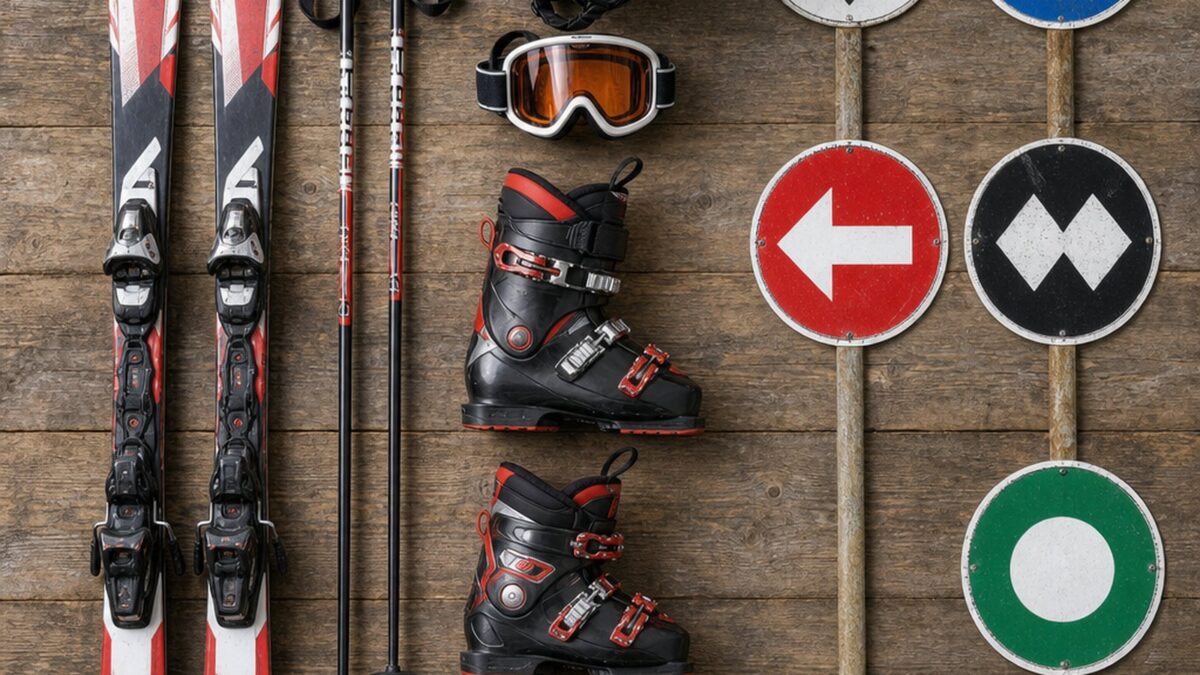
Piste colours indicate the difficulty of a ski run. In Europe, the system is typically: Green for very easy beginner slopes, Blue for easy runs, Red for intermediate, and Black for advanced or expert runs. Always ski on runs that match your ability level.
What is the difference between off-piste and backcountry?
Off-piste refers to any unmarked terrain within the ski resort's general boundaries, often accessible from a lift. Backcountry is terrain far outside the resort area, which is unpatrolled, ungroomed, and requires hiking or ski touring to access. Both require avalanche safety knowledge.
What is the 'fall line'?
The fall line is the most direct path down a slope. It's the route gravity would naturally pull an object. Understanding the fall line is crucial for controlling your speed, as turning away from it slows you down and turning towards it increases your speed.
What does 'carving' a turn mean?
Carving is an advanced turning technique where you use the edges of your skis to make a clean arc in the snow, much like a knife cutting. A perfectly carved turn leaves a thin, clean line in the snow and is very efficient, whereas skidded turns involve pushing snow to slow down.
Why are DIN settings on ski bindings so important?
DIN settings control the amount of force required for your binding to release your boot during a fall. A correct setting is crucial for safety—too low and your ski might release unnecessarily; too high and it may not release when it needs to, risking injury. They should always be set by a professional.
What is 'corduroy' snow?
Corduroy is the term for the grooved surface of a piste after it has been groomed overnight by a piste-basher (snowcat). Skiing on fresh corduroy first thing in the morning provides a perfectly smooth and grippy surface, which is a favourite experience for many skiers.